


STWA
-
Posts
198 -
Joined
-
Last visited
Content Type
Profiles
Forums
Gallery
Events
Store
module__cms_records1
Posts posted by STWA
-
-
The coalition to ban dihydromonoxide warns about this ubiquitous chemical.
Dihydrogen monoxide is colorless, odorless, tasteless, and kills uncounted thousands of people every year. Most of these deaths are caused by accidental inhalation of DHMO, but the dangers of dihydrogen monoxide do not end there.
Prolonged exposure to its solid form causes severe tissue damage. Symptoms of DHMO ingestion can include excessive sweating and urination, and possibly a bloated feeling, nausea, vomiting and body electrolyte imbalance. For those who have become dependent, DHMO withdrawal means certain death.
Dihydrogen monoxide:
is also known as hydroxyl acid, and is the major component of acid rain. contributes to the "greenhouse effect." may cause severe burns. contributes to the erosion of our natural landscape. accelerates corrosion and rusting of many metals. may cause electrical failures and decreased effectiveness of automobile brakes. has been found in excised tumors of terminal cancer patients.
Contamination Is Reaching Epidemic Proportions!
Quantities of dihydrogen monoxide have been found in almost every stream, lake, and reservoir in America today. But the pollution is global, and the contaminant has even been found in Antarctic ice. DHMO has caused millions of dollars of property damage in the midwest, and recently California.Despite the danger, dihydrogen monoxide is often used:
as an industrial solvent and coolant. in nuclear power plants. in the production of styrofoam. as a fire retardant in many forms of cruel animal research. in the distribution of pesticides. Even after washing, produce remains contaminated by this chemical. as an additive in certain "junk-foods" and other food products.Companies dump waste DHMO into rivers and the ocean, and nothing can be done to stop them because this practice is still legal. The impact on wildlife is extreme, and we cannot afford to ignore it any longer!The Horror Must Be Stopped!
The American government has refused to ban the production, distribution, or use of this damaging chemical due to its "importance to the economic health of this nation." In fact, the navy and other military organizations are conducting experiments with DHMO, and designing multi-billion dollar devices to control and utilize it during warfare situations. Hundreds of military research facilities receive tons of it through a highly sophisticated underground distribution network. Many store large quantities for later use.It's Not Too Late!
Act NOW to prevent further contamination. Find out more about this dangerous chemical. What you don't know can hurt you and others throughout the world.Write NOW to help stop the spread of this killer !
Coalition to Ban DHMO
211 Pearl St.
Santa Cruz CA, 95060If you're still clueless, here's some more enlightening information as to the colloquial nomenclature of dihydrogen monoxide.
The dihydrogen monoxide molecule is composed of two atoms of hydrogen and one atom of oxygen. Its chemical formula is notated by scientists as H2O. But most folks just call it water . . . snicker ! -
Scientists worried by the rapid spread of a small crustacean throughout Europe's rivers; and canals could be the next exotic invader in the Great Lakes. Dikerogammarus villosus, a small shrimp, is a hardy invader tolerant of a wide range of temperature, oxygen levels and salinity. Dikerogammarus villosus likes to take a bite out of other species, the ones it doesn't eat entirely will often die of infections. Scientists have nicknamed Dikerogammarus villosus, the killer shrimp. The shrimp comes from around the Caspian Sea and Black Sea and has spread through Europe by ballast discharge and canals. They average size for Dikerogammarus is 6 mm to 30 mm long and are voracious eaters and are blamed on the decline of native shrimp where they have invaded. If it does become established in the Great Lakes, it is feared it could alter the forage base. Its habit of attacking and biting other species including small fish, it could be very negative for the fishery. It is suspected it might feed on fry and fish eggs as well. Dikerogammarus may also be an intermediate host of acanthocephalan worms (a parasite of birds and fish) it is possible to infect humans. This worm lives in the digestive tract getting nutrients from its host.
Current recommendations that ships exchange ballast water at sea will do little in preventing the killer shrimp from finding its way into the Great Lakes. This shrimp is tolerant of salt water. Many ships crossing the Atlantic are loaded with cargo and therefore are considered not to have ballast water on board (NoBoB) because their tanks are nearly empty. These ships do not exchange any ballast water at sea. Ballast tanks are never emptied completely and can hold invaders. It is imperative that we adopt some strategy that will prevent invasive species from reaching the Great Lakes. I have made suggestions in the past, there is technology available, none will be effective until there is the political will to pass the laws that will prohibit exotic species introductions
By Tom Marks
Click here for more information on this new INVADER !
-
No matter what your favorite outdoor sporting recreation is we often take our right to participate for granted. Hunting, fishing and trapping have come under an almost continuos onslaught from very well funded organizations like PETA. We are fortunate however there are enlightened state representatives in states all around this country trying to amend state constitutions to preserve and guarantee our rights. Assemblyman Richard Smith (D) 149 has sponsored such a bill in New York. This bill is currently in committee we need to help by writing letters to our representatives in support of this legislation. Similar legislation is being debated and passed in many states, we do not want to be left behind.
A resolution to provide sportsmen in Missouri with constitutional protection of their right to hunt, fish and harvest game (House Joint Resolution 27) passed the House Conservation and Natural Resources Committee on February 18, 2004. Sponsored by Missouri Legislative Sportsmen Caucus member Representative James Whorton (D-3) along with nine other caucus members, the legislation is now waiting to be placed on the calendar for debate on the House floor. A similar bill (SJR 24), introduced by Missouri Legislative Sportsmen's Caucus member Senator Harold Caskey (D-31), has already passed through Senate committee and awaits debate on the floor of the Senate. Nine other states are addressing similar legislation: Indiana, Idaho, Georgia, Missouri, Michigan, Mississippi, Nebraska, New York, Pennsylvania, and Tennessee. Legislation has passed in Virginia, North Dakota, and Louisiana.
Sportsmen's Bill of Rights Legislation in Pennsylvania Representative Matthew Baker's bill proposing a constitutional amendment preserving the right to hunt and fish passed the House by a vote of 189-11 on February 9, 2004. The legislation awaits action in the Senate and if approved would be added to the commonwealth's ballot to be voted on by the citizens in November.
The Georgia House Game, Fish and Parks Committee addressed a similar constitutional amendment. The State Senate bill, SR 563, has already passed which overwhelmingly supported the amendment to their state constitution preserving the right to hunt, fish, and harvest game. The Senate passed Senator Eric Johnson's bill (SR 563) with 51 yeas to 3 nays and the House passed an identical bill, sponsored by Representative Gregg Morris, with a vote of 154 yeas to 14 nays. Both legislators are members of the Georgia Legislative Sportsmen's Caucus and Representative Morris is a Co-Chair. Each bill awaits action in the opposite body of the legislature before it is sent to the Governor and placed on the 2004 ballot.
The legislative fight across the country is not easy in Nebraska there has been some resistance. The Nebraska Legislative Sportsmen's Forum will be addressing similar legislation (LR 4 CA) in its state Senate. The bill faces an effort to halt progress due to objections to amending Nebraska's Constitution. It will take 33 votes to move the bill forward and bill sponsor and Nebraska Legislative Sportsmen's Forum Chair, Senator Ed Schrock is recruiting supporters.
The goal of protecting our rights as outdoor sport enthusiasts is not politically incorrect, as some would lead you to believe. Participating in the outdoor sports is a way of expressing an appreciation for our heritage and it is worthy of protecting from a few well-financed and loud minorities. The tradition of hunting and fishing is as American as apple pie, feel no shame because you enjoy the outdoors. Many of our state and national conservation efforts were started because outdoor sportsmen saw what pollution and unregulated commercial harvest were doing to the ecosystem. Again we need to support our legislators in making our rights law. Write a letter today before you do anything else
By Tom Marks
-
Spring is really upon us, I do not believe there is any chance of turning back now to the snow and cold of a winter like day. Tonight I heard the chorus of spring peepers, and it is music to my ears. For me there is nothing that announces the arrival of spring more eloquently than this tiny frog. The chorus is an introduction for the annual rebirth the takes place each spring. Spring peeper, Pseudacris Crucifer, its scientific name refers to the "X" on its back; it is amazing that such a small tree frog can make such a loud call. Seldom seen, most often only heard, they are only about an inch long. They have perfect camouflage a brown or green color and the irregular shaped "X" on its back allows the frog to blend well into the background. The chorus, which sounds like thousands of frogs "singing", in my backyard is probably only about a hundred. Only the male sings and the call can be heard for almost half a mile. This is the smallest frog in New York State and it is the first to call in the early spring. The male sings to attract a female to mate with. The female lays between 800 and 1000 eggs which hatch in a few days. The numbers of eggs is quite remarkable when you see how small the frog is.
The spring peeper starts life as a tadpole in a vernal pool or puddle in the woods; for about three months then metamorphose into an adult frog. The rush to mate early in the spring is so the tadpoles can develop into frogs before the puddles dry up in the summer. This nocturnal frog lives about three years, eating small insects, ants, and spiders. Spring peepers hibernate under leaves or tree bark in the winter emerging in the spring as soon as the ground thaws. This tiny frog uses glucose as antifreeze in its organs to keep them from freezing during the winter.
At sunset tonight go outside and sit back and enjoy the music!
By Tom Marks
-
Thursday, June 24, 2004 The Wall-I-Guys, a group of sportsmen from the Southtowns Walleye Association, Bison City Rod and Gun Club, East Aurora Fish & Game Club, Alden Rod and Gun Club, Erie County Federation of Sportsmen's Clubs, Erie County Fish Advisory Board, Erie County Department of Environment and Planning (Spencer Schofield) and the New York State Department of Environmental Conservation (DEC, Bill Culligan, Don Einhouse, Mike Wilkenson and staff), today stocked young walleye in the Buffalo River as part of the Buffalo River Walleye Restoration Project. The stocking took place at the Seneca Street Bridge in South Buffalo.
The first milestone was in the first week of May when the first walleye eggs were collected to start the stocking phase of this project. The walleye restoration project was started in 2002 when the Wall-I-Guys was formed.
DEC Region 9 Director Gerald Mikol, who was on hand for this initial stocking in the seven-year project, said, "Walleye are one of the most popular sportfish in Western New York. This stocking marks the beginning of a journey to establish a self-sustaining population of walleye in this urban river."
Spencer Schofield who, along with the DEC was instrumental in getting this project off the ground remarked with excitement what a great day it was for our local fishery and sportsmen. The weather was perfect and the river conditions could not have been better.
The eggs for this first stocking were collected from adult walleye caught in Cattaraugus Creek this past spring. The DEC's Chautauqua Hatchery provided the use of one pond to raise the fingerlings for the Buffalo River stocking. The Cattaraugus Creek walleye, a river spawning fish, which spend most of their lives in the lake were selected as the egg source because they return to the creek each spring to spawn.
The 28,000 fingerlings about 1 1/2 to 2 1/2 inches long, were transported to the Buffalo River and released. It is hoped that these walleye will imprint on the Buffalo River and return to spawn as their parents do on the Cattaraugus Creek. The Wall-I-Guys and the DEC would like to establish a Buffalo River walleye population that lives in Lake Erie and spawns in the river each spring. It is believed that the Buffalo River once supported such a river spawning population of walleye.
Approximately 105,000 walleye fry the excess from the initial egg collection were stocked in the river in May. The first adult walleye from this initial stocking are not expected to return until 2008. The stocking of the river is planned for the next six years. It is hoped by the year 2010 to achieve 5000 adult walleye returning. It is a goal of the group to restore a naturally reproducing, self-sustaining walleye population in the Buffalo River. If the project is successful we should see a more stable abundant walleye population in the in the Buffalo River and adjacent areas of Lake Erie and the Upper Niagara River.
Historically the Buffalo River had a river spawning population of walleye. However, by the early 1900's, the river had become too polluted to support any viable fishery. Heavy industry along and dredging of the lower river destroyed much of the suitable spawning habitat. In recent years, the pollution has been abated and the water quality is much improved. It is believed that fish can reach the suitable spawning habitat further upstream. The Restoration Project includes construction of a walleye-rearing pond on Erie County property adjacent to the river. Walleye will be raised in this pond by volunteer labor and with DEC supervision. When ready the fingerlings will be released directly in to the river, this will reduce transport injury to the fish. Water from the river will be used in the pond to increase the potential for imprinting.
Success is not guaranteed for this project there will be a lot of work in the future. However, the team and all involved are very optimistic.
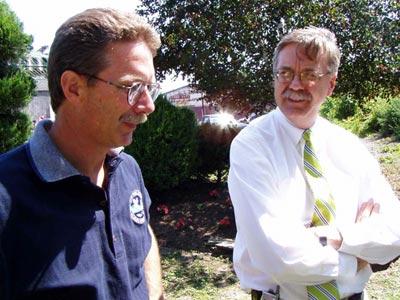
Paul McKeown, Supervisor of Fisheries NYS DEC, (left) and Gerald Mikol, DEC Region 9 Director on hand for the walleye release.
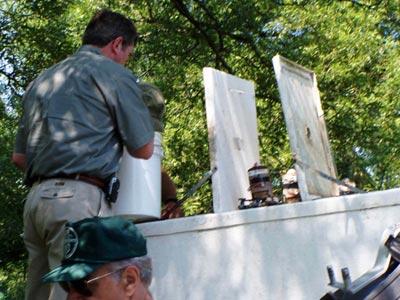
Eric Defries, DEC Biologist from the Chautauqua Hatchery getting the first pail of walleye to release.
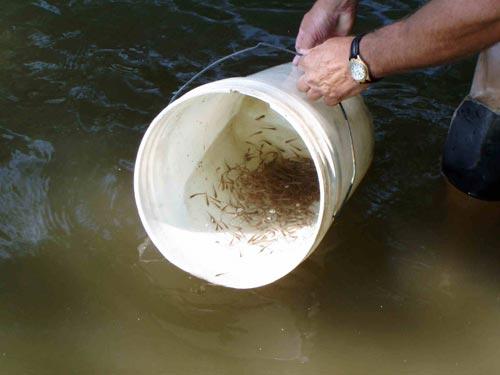
The first bucket of walleye fingerlings released into the Buffalo River, the restoration has begun!
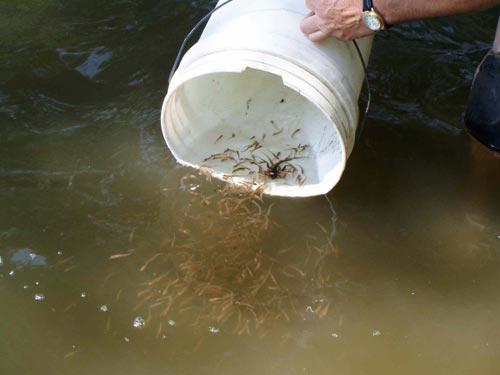
Released! Live long and prosper and y'all come back now!
-
In fall, walleyes can be anywhere, six inches under the surface in 80 feet of water or tight to bottom in 10 feet. Sound challenging? It can be, unless you know how walleyes drift off of structure and suspend in the vicinity of bait. Finding them is a looking game with quality electronics; catching them is a straining game with planer boards, spinners and crankbaits. The pattern holds true wherever you are, from Great Lakes to inland waters, and wherever walleyes are chasing baitfish. Which, it turns out, is everywhere.
The Baiting Game
The bait connection betrays the walleye's presence. In fall, when walleyes ramp up their feeding before winter, the fish will never be far from food. On the Great Lakes, you might see enormous pods of one- to three-inch gizzard shad skittering on the surface or as big blobs on a locator. Shiners and the like herd up as well on inland waters, and predators are never far behind.How do you find them? Start looking for structure on a map and then with electronics. Points, humps and weed edges are all fair game. But when you look with a quality locator that pinpoints fish and bait the key is to veer away from the structure and look over open water. If you've seen fish on structure at a certain level,15 feet, for instance, you can bet they'll be at that same depth over open water, from hundreds of yards to half a mile away from the structure.
Walleyes will do this day and night. The most important thing to remember is not to glue yourself to structure the walleyes will wander away from it if bait is present.
Search Mode
The best way to enter into search mode is to start trolling. This way you can cover water and zigzag to find fish. It would be far too time-consuming to jig or live-bait rig. Trolling, on the other hand, spreads lines to the sides of the boat and behind it, the better to cover a swath of water at different depths. I always try to maximize my efforts with the most rods possible and the greatest coverage. Enter planer boards, and inline boards the handy devices that veer lines away from the boat. With them, you can run more rods without tangling and pull lures through more territory.Which brings us to my two favorite offerings in fall. While few people fish spinners after summertime, the reliable crawler harness keeps working through October and even into November. You can boost up a size or two with your spinners in fall to tempt more big fish. If, for instance, you were using No. 2 blades in summer, you now might want to try Nos. 4 and 5. The heavier thrum is often just what the walleyes want when they're starting to feed with gusto before winter.
By November, though, I normally start switching to crankbaits. You can move them faster and cover more water (2.0 or 2.3 mph for cranks vs. 1.1 mph for crawlers), and since the fish are so keyed on baitfish, cranks will often do the job even better. Experiment with cranks and crawlers to find out. For the lures themselves, it's hard to beat Rapala Husky Jerks (in shallow and deep-running versions), Tail Dancers and Shad Raps. Again, match the colors to the prevalent baitfish and conditions-silvers around shiners and shad, brighter fluorescents in darker or stained water. You can trick out your lures with additional color with holoform tap from WTP, formerly known as Witchcraft. Add a strip of silver or glow to the lure's sides, something that's particularly effective at night.
If the structure is particularly steep or difficult to follow, you might want to try leadcore. I like it if I'm on a break that twists and turns and I'd have too much line out with boards. Even in 45 feet of water, you can often get down to the fish zone with 75 to 85 feet of line out
By Mark Martin
-
VHS Spreading to Other Great Lakes
Chicago, Il. April 13, 2007, Eddie Landmichl, Charter Captain and Environmental Activist says divers have reported the bottom of the southern basin of Lake Michigan is carpeted with dead fish, mostly gobies with some sheephead. They've been dead too long to autopsy, but Viral Hemmoraghic Septicemia (VHS) is suspected. Researchers in Wisconsin and elsewhere are very anxious to find out how extensive this die-off is, and are requesting everyone with underwater camera equipment to check their local waters for unusual quantities of dead fish on the bottom.
A Few Bait Regulations Explained
Anyone with a fishing license can collect baitfish for his or her personal uses (not to sell) however due to the special regulations restrictions apply. If you harvest your own bait it can not be transported in a vehicle over the road. Only on the water or by walking. The bait must be used in the body of water where it came from.
What if you possess commercial bait license and harvest bait intended only for your personal or private use? The regulations that apply are exactly the same for you as for individuals who do not possess a commercial bait license. You can not transport live or dead (salted or otherwise treated minnows) without a permit from the DEC. The commercial restrictions are in fact the same as personal restrictions on bait. A commercial license allows the business to harvest bait and with a special permit issued by the DEC transport the bait to a salt processing site. Frozen uncertified bait is treated as if they were live uncertified.
Frozen baitfish that is not certified can not be transported.
Purchased certified minnows can be salted however they still only can be possessed for seven days with the valid sales receipt.
For a complete list of frequently asked questions go to the web at: http://www.dec.state.ny.us/website/dfwmr/fish/fhregs.html
By Tom Marks
-
Woody, I have read over the new emergency and proposed regulations. Many of our initial concerns were addressed by the DEC. We now are not limited as to the amount of bait whether bought or personally collected. We can keep bait purchased for up to seven days. Connected waters like the Lake and Niagara River have been reconsidered as one body of water. The list goes on... What we need to do is understand we still have a problem, neither we nor the DEC created the problem. The DEC is responding the best it can, the bait and fish regulations could have been much stricter. The DEC is trying to protect the ecosystems beyond the Great Lakes that is a very important.
Many other people and I have been preaching for a long time "aquatic invasive species are the single greatest threat to the Great Lakes ecosystem" we have felt the impact by the changes to our fishery. Zebra mussels cleared the water not cleaned it as many people think. They have altered the entire ecosystem. Food once suspended through the entire water column is now concentrated on the bottom. No big deal? This could be the reason we have dead zones, botulism episodes and declines in some fish species. Gobies.. no big deal? They prey upon sportfish fish eggs, displace native fish, and are a vehicle for the transport of chemical pollution up the food chain.
Without any doubts we have felt the impact of these invasive species although it has not been felt directly in our wallets like VHS. However, despite what we think we have been paying for invaders like zebra and quagga mussels. Industries around the Great Lakes have to spend billions of dollars to clean water intakes, heat exchangers, plumbing, lost production due to down time as a result of extra maintenance. In the factory where I work we constantly have to address issues caused by zebra mussels in pipes. These costs have been added to our electric bills and the products we buy. These costs are forever that is the how insidious invasive species are once introduced they are here forever. It is just now with the high price of bait sportsmen are feeling the impact first hand. It will certainly be a hardship and inconvenience, but it is just the hard reality of an invasion.
I believe the DEC's response to our initial concerns were well addressed. The only issue I have now is public awareness of the severity of the problem, and the new regulations. This is not like any other fishing regulation change. It needs to be addressed in a manner that accents the importance of the countermeasures and prevention. I believe the DEC should send every holder of a fishing license a postcard alerting everyone of the VHS concerns and regulations. I believe that at every point of sale there should be literature distributed with the sale of a license. We can not wait for the reprint of the regulations book.
Will the costs or fears of invasive species "chase" people away from the outdoor tradition of fishing... most likely yes. I recall when mercury was discovered in perch back in the 1960's and the first health advisories were issued, my father stopped fishing. What once was a weekly tradition of catching our supper ended abruptly. As a kid my whole life changed, what was once very important was gone. There maybe kids today who will have the same experience and same sudden change in their lives; I hope not.
We have an opportunity let's not miss it. Too often events seemingly out of our control change our lives. We are like pawns on a chessboard being moved by more powerful entities. Power is in most part just a perception. Well, we can become that powerful force. We have seen the impact of our letters. Our club founders were powerful they did the impossible, got gill nets banned. Yet they were no different than you or I today. They were inspired, organized and drivers of an idea that was right. We can stop the invasion of aquatic invasive species, it is as easy as closing the St Lawrence Seaway or disinfecting the ballast tanks of all ships that cruise the Great Lakes. Let's follow the example of our club founders and make a positive impact on the health of our ecosystem. Let's be drivers of change not be driven by change.
By Thomas Marks, NY Director, Great Lakes Sport Fishing Council
-
Last Friday I was roused from a sound sleep by wife's excited calls from the kitchen."Coyote! Look is that a coyote? Quick! Get up! Look!" Sure enough it was a prime example of an eastern coyote that was hunting around our backyard. He was there for about three minutes and then he was gone. I was glad to have gotten up and find my glasses quick enough to see this animal.
Considering how common the coyote is, it is not often seen. It is estimated that there are over 30,000 scattered around New York State. The coyote we are more familiar with seems to be the western species; it is a little more visible in its natural range of the open prairie. The western species of canis latrans is much smaller (25 to 35 pounds) than our eastern species (45 to 80 pounds).
The excitement of having seen a coyote from the comfort of my home, my wife and I had a great topic for the breakfast table. We hypothesized what it was hunting for. It was almost forty-five minutes since we saw the animal when he came trotting back into our yard. Again we scrambled to the window to get a good view, and as fast as he arrived he left. Now my wife was worried that he was looking for dinner, either our little dog, Muffin, or the neighbor's cat. The cat has not been seen lately so maybe the coyote was only here for dessert. Okay, I have a dog named Muffin, you can stop laughing; it was my daughter's dog. He is a very smart dog; he just has a funny name.
Rather shy the coyote tries to avoid human contact and does most of its hunting after dark. Because of their shyness you would think they would live as far from humans as possible. Coyotes eat small rodents, squirrels, rabbits, insects, berries, and when the opportunities are right, deer or turkeys. They take advantage of any offering which includes carrion, small pets (dogs and cats), pet food left out for fido, or open trash. In fact their preferences for food makes living near humans worthwhile. So, it is not unusual to see them or hear their howls in suburbia or even the city.
There are several theories how coyotes arrived in New York State and eastern North America. The first is that they were actually here when the settlers first arrived in North America but retreated to the north as the land was cleared. When the reforestation started back in the early 1900's the coyote moved back. The second theory, which is currently more widely accepted, is that the western coyote expanded its range eastward, once established here it evolved into a distinct larger subspecies. The third theory, which is gaining acceptance, is that the eastern coyote is actually evolved from the red wolf or northern gray wolf. Some interesting DNA analysis is being done to trace their lineage. The evolution is about 300,000 years in the making. The study will take a few years and after reviews from genetic experts we should know the most likely theory.
Coyotes are very territorial with a home range between 6 and 15 square miles. The females give birth to their pups in March or April, and a litter can be as many as a dozen pups or more. The pups, when grown, are driven away by the female. They will travel hundreds of miles to find vacant territories of their own. It is possible for coyotes to breed with domestic dogs. However their breeding cycles do not coincide making this difficult yet genetically it is possible and has happened. The hybrid offspring have their pups in January, a tough time for the young to survive insuring to keep the coyote bloodline pure. Coyotes actually would rather dine on than breed with domestic dogs.
Muffin tells me the neighbor's cat is still with us; he was just at the door looking in on Muff. I told you Muffin was smart.
By Jon Smith
-
To become a fisherman I am undergoing or struggling through another evolutionary phase, it is a life long process, which started when I was a kid. My dad tried to give me a jump start by skipping the stream angler phase however he learned you can not skip any steps in turning a little kid into a fisherman especially when you are starting him on a journey that will last a lifetime. I should explain to become a fisherman there are specific phases or steps. Fishermen are proficient in all aspects and techniques of fishing. A fisherman respects the resource, the written as well as the unwritten rules of fishing. He respects the "space" of other fishermen not crowding or infringing on someoneÕs spot. A fisherman does not litter the stream or lake and usually picks up any trash he sees.
I have told the story before about my first trip with my dad to Findley Lake when I was four years old. He rented a rowboat, skipping the stream phase of my development. I cried in protest so loud that he rowed straight back to shore. I laugh when I recall that day I can remember my dad trying to calm me down so we could fish. He tried to get me out in a boat one other time; it was on Lake Erie. No success in that attempt either, and as quick as we got on the water we were back on shore. That start was a small mistake and I can understand my father's impatience to make me into a fisherman however the stream phase of the evolution can not be skipped. Thank goodness he never gave up and realizing his mistake he got me back on course for my life long evolutionary journey to become a fisherman. I actually recall going to Cassadaga Lake outlet as a little kid to fish for sunnies. There were outings to 18-mile creek where we fished. I do not recall any successes on 18-mile as a little kid, this stream is still a challenge for me. I evolved into a trout angler in Allegheny State Park on Quaker Run. It was on these waters that I learned how to detect a bite and set the hook. During those summer vacations during my youth in the park it was my cousin, Paul, and my mission to catch the Friday dinner. We took the mission seriously and thatÕs all we did was fish until we had enough for two families to eat. It kept us busy and out of trouble, not that we were trouble makers.
Before the Lake Erie tributary regulations the trout opener was April first. You could not fish open water prior to that. It was a tradition for everyone or anyone who knew anything about fishing or ever thought about wetting a line. The anticipation of that opening day and the excitement for a little kid was special. Some of the excitement was lost when we started fishing the Great Lake tributaries year round. I remember lessons in etiquette and good sportsmanship. On one opener we camped near Allegheny State Park. On Quaker Run I found a landing net; my dad told me to put it back where I found it because the angler who lost it would surely return looking for his net. We returned to our camp and our folding chairs we had left in camp were "borrowed"É we left before the person could return them.
At some point during one of those summer trips to Allegheny, my dad reintroduced me to fishing from a boat it was on Redhouse Lake. It was a natural progression, or evolution in the journey to become a fisherman. However, I never really got into boat fishing until I was about twelve years old. My dad bought a boat to fish Lake Erie. It was a project boat, a sixteen foot wooden Penn Yan. It was probably about ready for the bonfire but my dad saw something special in that boat. Every member of our family put hours into sanding, cleaning, painting, staining and sealing. When he finished the boat project it was a beautiful craft. The front deck was mahogany and it looked showroom perfect. I believe it was all the work and getting to know the craft in such intimate detail that gave me a sense of security when we launched it on Lake Erie. It was in that boat that my dad introduced me to Lake Erie smallmouth bass, to this day I still love to fish for bass. I can remember a lot of trips out to the ÒreefÓ and drifting over house sized boulders barely visible. Perch runs to the weedbed were a favorite trip; it was all part of the evolution into a fisherman carefully orchestrated by my dad.
Now as I struggle to catch a fish from the bank of a stream I have come full circle, evolved to the stream again to become a more complete all round fisherman this time with a bit more sophistication and a fly rod. My father has retired to Florida and canÕt be on the streams with me today, however I am armed with all those lessons he taught me during my youth. I guess the point of this reflection on my journey is for all you dads; there is no better journey you can set your kids upon than to become a fisherman.
By Rodney Long
-
Tossed like a bit of flotsam upon the white capped waves, chilled by the wicked northwest wind, and nearly drowned by the spray off the waves my thoughts are of tranquil, warmer waters. I ask myself that most serious of questions, one that originates from deep within, the very center of my being, from the pit of my gut, "WHAT THE HELL AM I DOING ON THE LAKE WITH WAVES THAT COULD KILL ME ?" "WALLEYE!" I shout from the top of my lungs to be heard over the howl of the wind, raging against me, brought on by an angry God who must have damned me for pursuing his noble beast of a fish.
God's temper is a fury cast upon me for the quest of this fish. I suffered; tossed in my boat, rigging lines to catch a beast. I want to see its toothy grin as I pull him from the chaos. Waves slap over the gunwales, as the wind blows like the Bull of Barney a beast of a breeze. Soon my trousers will be stained as fear tries to rise from the pit of my stomach. "I WILL BATTLE THE GODS' TILL I AM VICTORIOUS! I WILL CATCH A BEAST!"
Breaking the crest of a wave the boat slides into a bottomless trough. The next wave breaks over the bow. "DAMN YOU LAKE, I WILL NOT BE DEFEATED!" The angry seas have turned black, capped with white foam; I turn the boat to quarter across its wrath. There is an angry roar from the waves trying to fill my boat. Holding the wheel to stay onboard and keep the course true, my eyes watch the rods for any tell tale sign that a beast is there.
One rod in the downrigger with a worm harness of green and black with a big eye, Paul Stoos created this harness he swears it possesses magic. The rigger is set down only to 10 feet and 140 feet back for the harness. Lead core, three colors out with a copper willow leaf with orange and green sparkle blades and crawler for bait seventy five feet to the port on an inline board for my second rod. One point four on the GPS and one point one on the subtroll, water temperature a frigid 55 degrees. DAMNED this is a cold spring, it has chilled the fish, froze them, and given them lockjaw. The water is so cold the crawlers canÕt drown; they stiffen up like pencils. DAMN this cold; let go; it should be June. Wait! There is a mark of a big fish on the Lowrance LCD screen, a long red tell tale sign in the hook, it is a WALLEYE!
The tempest rages, never the less I am driven to fish on by the mere thought of catching a beast. BLACK WATER, WHITE CAPS that could swallow a boat in one gulp, gone forever into the abyss. That is the hell called the Eastern Basin of Lake Erie, and I am here to do battle. "FISH ON!" The starboard rigger trips I grab it and take in the slack. "DAMN, NOTHING." I quickly bring in the worm harness to check the bait. I put on a new crawler, re-rig the line into the downrigger. It is a big disadvantage to fish alone in this hell, nobody to steer when hauling in a fish. Nobody to man the net, that could be bad.
FISH ON! FISH ON! The rigger tripped! Run with the waves, it is all I can do to maintain control. A four-footer goes over the bow for good measure before I can turn and grab the rod. RUN WITH THE WAVES A BEAST IS HOOKED! The wind blows a cold spray at me; I feel the head shakes; it is a big beast. The magic that Stoos put in his harness has worked, now I must focus on the battle. The boat pitches in the turmoil, I almost loose my footing and fall to the floor. THE GODS HAVE BEEN ANGERED! A cold hard rain begins to beat on my brow. I am only cooled in battle not defeated. The line counter says only forty feet to go. I reach to get the net ready, only twenty feet left I have not seen the beast yet he holds deep and shakes his head more fiercely to break free. I CATCH A GLIMPSE OF GOLD! THE BEAST IS HUGE! The beast makes a plunge and takes line off the drag. I fight back and bring the beast to the surface now it is thirty feet to go. I reel and see the noble fish on the surface. I reach with the net and carefully guide its head in; it is mine "I HAVE WON!"
I carefully lift the fish from the net, beautiful not a mark on it. The Berkley digital scale reads 10.85. For just this moment all seems calm, quickly now, back into the water so this beast can live. I won but I won't kill my beast, catch and release to conserve this creature for tomorrow.
I turn the boat into the waves and head back to port. Breaking the crest of a wave the boat slides into a bottomless trough. The next wave breaks over the bow. I laugh out loud, "I DARE YOU LAKE, I AM THE VICTOR TODAY!" The seas are black, capped with white foam; I turn the boat to quarter across its wrath. There is an angry roar form the waves trying to fill my boat. Holding the wheel to stay onboard and keep the course true. I see the harbor and its refuge from this chaos. I smile and know I will be back again to do battle with another beast. In port, refuge awaits, clean dry clothes, hot beverages, and friends to swap tales of beasts caught yesterday and today. We all live to cry out, "FISH ON!"
by Alex "Catch" Scheckel
-
I have been out fishing a few times not as much as I would likeÉ that would be every day. My wife has something to say about that, she is not a fisherperson, nor a fan of my fishing exploits. Her idea of fun is to see me working around the yard, or just working period. With the tournament here I hope my pre-tournament practice was worth it. Look, the time spent in practice is work nobody likes work but it has to be done, ask my wife. Practice is an investment toward success and rewards. It is a result of time and effort.
Investment and success are the important words here, take your weekly pay if you are disciplined enough to save (invest in a CD or municipal fund) just ten percent of your weekly income at 4% interest in ten years you would have $649.29 for every dollar you saved. You would have put in the bank over the period just $520 and got a return of $129.29 that is almost 25%! In twenty years you would earn over 50% return on your savings that is amazing and over that period as your pay increases the amount you put in the bank/invest increases, you could be a millionaire in no time at all. Then my friend you can go fishing every day. Twenty years may sound like a long time if you start young you will not even notice the time passing. You will be busy with the family, work, and getting ahead. It will seem like no time at all when you will be reaping your rewards.
This year with the high price of gas I am approaching the tournament differently. I am trying a ÒnewÓ technique. I will troll when necessary but I know that big walleye are just sitting out there on structure and will hit bait bounced along the bottom. Controlled drifting and jigging to put the bait in front of big walleye is not really new just forgotten by many however, to the young fishermen it is new.
A jig tipped with a minnow or half a crawler bounced over structure is dynamite, many of the pros on the walleye fishing circuit rely on this method. It is cost effective because you do not burn gas all day. Here, lets look at some numbers, the cost of gas we will assume is $4.00 a gallon. When you troll for eight hours the trip usually burns close to ten gallons. Jigging is usually closer to shore so the runs are shorter. So say you conserve 4 gallons (that would be enough to troll a couple hours plus jigging). Over the summer you plan to go out twice a week, fish 7 of the 9 tournament days, for a total of about 33 trips to fish. If you save 4 gallons a trip you just saved $132. That is enough money to take your wife out for a very lovely dinner or buy yourself a really cool reel. On the other hand, if you bank the savings in twenty years it would be worth $278.10 at the 4% interest figure we used earlier. 4% by the way is conservative you should be able to do better. Nevertheless, let me tell you this, the dinner with your wife will pave the way for future allowances for you to go fishing, consider it an investment for the future. So here it is $132 gas savings, or $278 return on your investment, or dinner with the wife priceless, you make the call.
by Y. R. Moneyworth
-
by Spencer Hunt
THE COLUMBUS DISPATCHLOUDONVILLE, Ohio -- State and federal officials are tracking an escaped killer. Armed with nets, a plastic dinghy and a 300-volt generator, a team of fish experts spent a day last week collecting fish from the Clear Fork Branch of the Mohican River, looking for a deadly disease called viral hemorrhagic septicemia.
Officials thought the contagious virus, which makes fish bleed to death, was contained in the Great Lakes. But the discovery of VHS in the Clear Fork Reservoir in Morrow and Richland counties has changed all that. It's the first discovery in a U.S. waterway that doesn't drain to the Great Lakes. "The bug is out," said Ken Phillips, a U.S. Fish and Wildlife Service microbiologist based in La Crosse, Wis. "In theory, it could make it all the way to the Mississippi River." Phillips and three other Fish and Wildlife biologists were in Ohio last week dissecting hundreds of fish shocked and netted from linked streams that flow from the Clear Fork to the Ohio River.
Although not a threat to humans, the disease can kill trout, perch, walleye and other fish by the thousands. There is no way to stop its spread or kill the virus. "It could be devastating," said Larry Mitchell Sr., president of the League of Ohio Sportsmen and the Ohio Wildlife Federation. In 2006, the virus killed tens of thousands of freshwater drum and yellow perch in the western basin of Lake Erie.
VHS is a threat to state hatcheries as well, where sport fish are bred for release in Ohio lakes and stream. Two hatcheries, one near London in Madison County and the other near Castalia in Erie County, are under quarantine while officials await results of VHS tests.
The London hatchery received virus-contaminated muskie eggs from the Clear Fork Reservoir in April. The hatchery sent about 55,000 potentially infected rainbow trout to Castalia, said Elmer Heyob, hatchery administrator for the Ohio Department of Natural Resources.
If tests for the virus are positive, the state would have to kill more than 400,000 muskies, brown trout, rainbow trout and steelhead trout at the hatcheries, Heyob said.
"Then we would have to decontaminate the hatcheries with chlorine," he added. The value of the fish at both hatcheries is more than $480,000, according to Ohio Department of Natural Resources estimates
First discovered in Europe, the disease somehow migrated to the Great Lakes. Researchers identified it after a fish kill in Lake Ontario in 2005 but now suspect it was in Lake St. Clair as early as 2003. VHS becomes deadly once fish are under stress because of spawning, another disease or low oxygen levels in water. Lower water temperatures also help VHS replicate.
The virus was discovered after routine tests of ovarian fluid from the Clear Fork muskie eggs. Heyob said he's hopeful that the disease hasn't spread among all the hatchery fish, which are kept in separate tanks and ponds.
However, he and others will have to wait some time to find out. It takes two to four weeks for test results, Phillips said.
Still, both are hopeful that tests on the stream-caught fish will show how far and how fast the disease has spread downstream.
"It could have been in the reservoir a year or two years ago and we're just now detecting it," Phillips said. "How long it could take to move is anybody's guess."
Click Here for a downloadable PDF on this Killer !
-
At the July meeting of the Southtowns Walleye Association of WNY, it was good to hear the outrage of the members about aquatic invasive species. It all started after NYS DEC Lake Erie Unit Manager, Don Einhouse's presentation when some one asked about transporting emerald shiners and VHS. The debate was heated but finally settled on how do we stop the next invasion. The consensus was, even if we can contain VHS something else is coming and it could be worse.
Shippers and conservationist groups all agree that ships bring in the bulk of the invasive species in their ballast water. Shippers will not spend the $1 million plus per ship for onboard treatment systems until the government sets the treatment level. The big hitch is our government has not been able to say how effective the treatment needs to be or the acceptable level of living organisms in ballast water. (I believe the level is simple because we can not afford any new invader to come in to jeopardize the fishery and human health, zero tolerance for living organisms.) Whose fault is it, the politicians who do not have a clue as to the severity of the problem or the shipping lobby? I can almost understand ignorant politicians, but they have to ask the experts when they do not know the answer that is their job. If they are too ignorant to research the issue it is time to fire a few and get someone in there who will get the job done.
Why would the shipping lobby try to stall the efforts for legislation when they agree that ballast water is the vector for aquatic invasive species invasion? Simple the more stringent the treatment level the more it will cost them to refit ships. Some ships may even be impossible to refit to meet the toughest treatment levels, zero discharge of living organisms.
There has been debate by conservation groups and political leaders about closing the St Lawrence Seaway to all ocean vessels until a way can be found to stop ballast water invaders. The argument against the closure is it will cost too much for shipping around the Great Lakes. Before we look at cost consider this, since the opening of the Seaway in 1959 overseas shipping on the Great Lakes has been in a steady decline. The reasons are many but a big reason is our industrial centers have shifted to the southern states and overseas. There is less than two overseas ships a day entering the Great Lakes. At this level it makes the Seaway a luxury not a necessity.
A federally funded study released in mid July said invasive species dumped into the Great Lakes is costing the economy $200 million dollars a year. The cost of closing the Seaway in added transportation would be $55 million a year. We do know there is an average of two new species introductions a year, we do not know the environmental or the economic impacts for each new species. It could be benign or deadly. If we close the Seaway we get stuck with a $255 million dollar bill a year (the cost of the present invaders never goes away). If we leave it open we gamble that we will not get any new invaders that will impact the ecosystem, human health, or the economy. If we use history as our guide we can expect that $200 million dollar bill to grow. Since I am using the most recent study IÕll go with that figure but some figures would lead you to believe the current cost is much higher. Wisconsin did a study they said zebra mussel control cost Wisconsin Electric Power Company $1.2 million a year. The estimated annual cost of controlling zebra mussels in the Great Lakes now range from $100 to $400 million, according to NOAA Great Lakes Environmental Research Laboratory Director Dr. Stephen Brandt. (A government agency we paid to study the issue.) Sea Lamprey control costs over $30 million a year for treatment and research. The bottom line is the $200 million figure is, the very conservative cost could actually be much higher.
What will a new invader cost? At least several million dollars for research. We can not afford another invader just on an economic basis.
At less than two ocean ships a day the Seaway is a luxury. In this era of economic difficulties we should close it. We will protect the ecosystem from invasive species in addition we will save the operation fees. We wonÕt need to pay the high salaries for commissioners. The money saved could be used for rehabilitating the damage already done to the environment caused by the Seaway operation. At less than two ships a day what the heck do the people manning the locks do all day? Folks we are wasting money.
Get outraged! Less than two ships a day and we are killing the fishery and ecosystem! Get outraged, call your congressman and tell him he has his priorities wrongÉ protecting human health should be number one, the ecosystem should be next and followed by our economy. He can do it in one simple stepÉ CLOSE THE CANAL! GET OUTRAGED! IF YOUR CONGRESSMAN CANÕT GET THE JOB DONEÉ. GET OUTRAGED AND FIRE HIM! YOU HAVE THE POWER YOU HIRED HIM; DONÕT LET HIM FORGET IT! LESS THAN TWO SHIPS A DAY IT IS OUTRAGEOUS!
by Tom Marks
-
By the most recent creel survey results from the NYS DEC for July there is not better time to be perch fishing than right now. The harvest was 4981 perch in July '08 compared to 1601 in July '07, a 312% increase! For the month of July '08 the harvest rate (harvested fish per hour) is up 107.7% over last July. For the season (May '08 to July '08) the harvest rate is up 162% that tells me there are a lot of perch to be caught this summer. Angler effort is up this July 192% over last July and 147% for the season. The over-all perch harvest for July '08 was 3459 perch, up 312%, in July 07 only 1108 perch were harvested, the season harvest so far is up 268% over 2007. This is a tremendous increase and it reflects well on the state of the perch fishery. Walleye results are up as well for July and the season; we have a great fishery. This should be obvious Lake Erie is one of the Great Lakes.
Frankly, I am quite puzzled by the creel survey results when I look at factors that should have caused the figures to continue to trend down. The price of gas is 34% higher than in July '07. I know anglers are fishing less due to the price of fuel. Fishing license sales this year are down 18% from 2007 so we know there are fewer people fishing. This summer windy conditions seem to be more common restricting the days (opportunities) anglers can get out on the lake; at least from my perspective. Many anglers were outraged at the price and availability of emerald shiners last summer and this was blamed on the drop in perch angling effort in 2007. The price is the same in 2008 or slightly higher due to the increased in fuel prices. The effort figures (up 191% over July '07) surprises me. Does the higher angler effort suggest an answer? Despite fewer anglers caused by lower license sales, higher gas prices, less opportunity, and expensive bait; are anglers are fishing longer on each trip? Longer time on the water (more hours) would increase the effort. Have the local bait shops and the bait distribution networks resolved last year's issues with the supply of emerald shiners? Have the anglers that stayed away from fishing last summer due to the price of bait and the new regulations, accepted the changes and begun to fish again?
I believe the increased effort indicates an attitude change and acceptance of the new regulations, and higher costs. The inconvenience of certified bait and higher fuel prices, when compared to the value of the catch (perch are about $15 a pound at the market) and the experience, it is still inexpensive to go fishing. The great harvest figures tell the story, everyone who fishes for perch are catching them with abandon so despite the negatives on paper get out and enjoy the fishing!
by Tom Marks
-
I have heard the whispers; "he fishes for bass". "What is a walleye club member doing fishing for bass?" "He ain't a real walleye fisherman if he fishes for bass."
Yup, I fish for bass, perch, steelhead, pike and anything else that swims and how is it all those died in the wool walleye fishermen who whisper behind my back fish for perch, trout or cod? Are they not purists? Not hardly, I would think. I understand I hope we are all fishermen at heart and as I often say, "the tug of a fish is magic . . . " I hope it is what bonds us together, a brotherhood of fishermen.
Every time I fish I believe it is a tribute to my father and the lessons he taught me on the stream or on the lake in a boat. All the lessons were not about fishing often they were about life and I believe they have helped me through tough times and helped me recognize and enjoy the good times.
My dad worked two full time jobs most of the years I was growing up. Therefore, the times I got to spend with him fishing were very important. Those years were in the late 1950's and 1960's and we always talked about fishing for yellow pike and missed the days of the blue pike. Our fishing trips were not that regular with his work schedule. It seemed we would plan for weeks and hope the weather cooperated. We would fish for what ever was biting and seldom did yellow pike fit into that category. Lake Erie was fast becoming an open sewer at that time and yellow pike were not that common. We caught perch, lots of perch, and bass. Bass were exciting, jumping high out of the water, what more could a kid want?
I discovered the Mepps Spinner about 1960 and with it I caught a ton of bass. There was no other better lure for me. I would fish the "Docks" in Grandview Bay all summer long catching bass. When my dad had time we would go out to the "reef" in our 16-foot Pen-Yan and fish for bass with soft-shell crabs that I caught in Delaware Creek. To this day I remember a big bass that I had hooked that jumped clear over the bow of the boat and straightened the hook. We relived that story for years always wondering how much that bass would have weighed.
My first yellow pike came when I was 13 years old. I was fishing just outside the weedbed in Grandview Bay for perch when I caught that yellow. It was small about 15 inches but it was a yellow. That summer I would catch quite a few more off the "Point" near the "Docks" but it would take a long time before I would catch a big walleye. I caught my first six pounder in 1973 right in front of Sturgeon Point. I know it, because that was the year I sold my Starcraft Boat. I didnÕt own another boat until 1993.
The 20 years between 1973 and 1993 I experimented with all kinds of fishing. I took up salmon fishing on Lake Ontario, fishing out of my best friend Joe's boat. I fished the streams again as I did when I was a kid. I fished ponds for bass. I bet you I knew almost every pond in Western New York and had access to most. We have some great pond fishing for bass.
You may not think that stability is an important factor when it comes to designing in-line planer boards for walleye fishing, but the truth is, stability is probably one of the most important characteristics a walleye trolling board should have. Without it, the board would topple over at rest, be unable to plane cleanly in rough water, and generally would not perform adequately at the slow speeds we often use for walleye trolling.
I love my dad and if it weren't for him I would not be a fisherman today. I wish he could still fish today and we could share our passion for the sport. I love to fish. The tug of a fish is magic. It is hard to explain there is no other feeling like it. I am not sure if it is the mystery of what it could be or the feelings it stirs of the memories from my youth, fishing with my dad. I can assure you that every fish no matter how big or small I feel the same excitement as I did when I caught my first fish. When my father taught me to fish he gave me a gift that would last a lifetime. It is a gift I will pass on to others and someday to my grandchildren if I am blessed.
So I am a walleye fisherman, bass fisherman; a fisherman . . . say what you will but I wouldn't have it any other way, for the love of fishing.
by Tom Marks
-
- Check the coupler on the trailer. Make sure all parts move freely and are rust and crack free. Lube as directed in owners manual.
- Inspect trailer jack and wheel. Lube pivot shaft and wheel if necessary.
- Check all running lights.
- With the boat off the trailer, inspect either bunks or rollers for excessive wearing, broken board, torn carpet, or loose or missing bolts.
- Both bearing and brakes if applicable should be serviced by a certified mechanic yearly.
- A good coat of wax once or more a year will help in both looks and longevity of your trailer.
- Check the level of electrolytes in all batteries. Add only distilled water and fully charge after every use.
- Check battery post for corrosion.Inspect fuel systems for any odors, leaks, or deteriorations.
- Do steering systems work smoothly both ways? Grease the steering cable if needed. Look for any loose bolts and signs of breakdown.
- Inspect navigation lights for corrosion and make sure they work properly.
- Inspect bilge and aerator pumps to make sure they are also working properly.
- Do live wells drain properly?
- Check intake screen for obstructions.
- Check the horn.Are drain plugs installed and tight?
- Check trolling motor pull cord if applicable. Look for fraying or cuts. Replace if you see any visible wear.
- Is prop secure and void of cracks or deep nicks? Replace if necessary.
- Is the fire extinguisher in good working shape and secured? Replace if there is any doubt!
- Are life jackets and throw cushions in good shape?
- Check each one for tears, and replace as needed.
- Clean and wax all parts of the boat. It not only makes your rig look better but will help in its resale if done on a regular basis.
- Check anchor rope for wear or aging. Replace as needed.
- Do you have a basic tool kit onboard?
- Make sure all tools, fuses, and bulbs are accounted for and in good working order.
This article was written by Randy Patzner. Randy is a certified Mercury mechanic who has worked at Starks Sport Shop in Prairie du Chien, Wisconsin for more than 20 years.
-
A new 'dead zone' has been found in Lake Erie, which struggled back from contamination before.
Zebra and quagga mussels from the Caspian Sea could be to blame for a new "dead zone" recently found in central Lake Erie, an area where dissolved oxygen levels are low enough to endanger fish and other water life.
University of Waterloo biologist Ralph Smith suspects the mussels also contribute to unwanted algae growth and cloudy water along the beach-lined shore of the eastern basin.
He's among a number of Canadian and American researchers trying this summer to understand how the two mussel species and other invaders such as the round goby fish are affecting the lake's chemistry and biology.
Erie was threatened once before by low oxygen, the result of decaying algae that grew in overabundance because laundry detergents and sewage were pumping in huge quantities of the plant fertilizer, phosphorus.
Scientists spent years figuring out the processes at work, creating a model that allowed them to predict how the lake would react to changes, and convincing society to control phosphorus.
The lake's health improved, the water became clearer and beaches were cleaner, but invasive species now appear to be causing such dramatic effects that the model may no longer apply.
Dime-sized zebra mussels were first found in Lake St. Clair, near Windsor, in 1990. They have since spread throughout the Great Lakes and beyond.
They established massive colonies on the bottom of eastern Erie, but Smith says they've since been almost entirely replaced by their quagga cousins, for reasons not yet understood.
The filter-feeding mussels are so numerous they've vacuumed up enough tiny plants and animals to make the water much clearer in many places, but at a price to other species that depend on the same food.
In addition to clogging intake pipes at power plants, factories and municipal drinking water systems, it now looks as if they could be changing the lake enough to encourage algae growth and make the water murky along the shores where people play.
The murkiness results, Smith suspects, from small particles sucked up by mussels in the shallow, nearshore areas that stay there and don't wash back out to deeper water. In addition, their fecal waste acts as fertilizer for algae that's becoming a nuisance on beaches.
He and other scientists are also intrigued by the bottom-feeding gobies, fish that grow to about 17 centimetres in the lakes. He says these fish "have arrived in the east end of the lake in fantastic numbers.
"They will eat small mussels (including zebra and quagga) for sure, and bass will eat the gobies, so life for smallmouth bass looks to be good for awhile."
But no one really knows the long-term effects of what's happening.
Before the mussels, "we didn't have any organism that would attach to the bottom and filter large quantities of water. The freshwater temperate zone never had that.
"So the mussels perform a completely new type of ecological function that will persist unless the gobies can harm them enough to reduce their impact."
Eric McGuinness
At first, it seemed no other creatures were preying on the mussels in the Great Lakes, but some duck species are feeding on them and they're turning up in the guts of perch, walleye, sheepshead, carp, white bass -- almost all fish except smelt and rainbow trout.
But Smith says researchers don't yet know how many mussels the fish are eating, whether they like the shellfish, whether they offer good nutrition to the fish or how fish are affecting the mussel population.
"Sheepshead probably eat a lot, and gobies more, the little ones. They have the potential to bring the mussels under some degree of control."
In Polish lakes and other places in Europe to which zebras and quaggas have spread, populations reportedly rise and fall unpredictably. Storms can scour them off shorelines, and they may be subject to diseases, but little is really known.
Smith says: "What are gobies going to do? I'd love to know."
By Eric McGuinness
-
In fall, walleyes can be anywhere . . . say, six inches under the surface in 80 feet of water or tight to bottom in 10 feet. Sound challenging? It can be, unless you know how walleyes drift off of structure and suspend in the vicinity of bait. Finding them is a looking game with quality electronics; catching them is a straining game with planer boards, spinners and crankbaits. The pattern holds true wherever you are, from Great Lakes to inland waters, and wherever walleyes are chasing baitfish. Which, it turns out, is everywhere.
The Baiting Game . . . The bait connection betrays the walleye's presence. In fall, when walleyes ramp up their feeding before winter, the fish will never be far from food. On the Great Lakes, you might see enormous pods of one- to three-inch gizzard shad skittering on the surface or as big blobs on a locator. Shiners and the like herd up as well on inland waters, and predators are never far behind.
How do you find them? Start looking for structure on a map and then with electronics. Points, humps and weed edges are all fair game. But when you look with a quality locator that pinpoints fish and bait the key is to veer away from the structure and look over open water. If you've seen fish on structure at a certain level, 15 feet for instance, you can bet they'll be at that same depth over open water, from hundreds of yards to half a mile away from the structure. Walleyes will do this day and night. The most important thing to remember is not to glue yourself to structure the walleyes will wander away from it if bait is present.
Search Mode . . . The best way to enter into search mode is to start trolling. This way you can cover water and zigzag to find fish. It would be far too time-consuming to jig or live-bait rig. Trolling, on the other hand, spreads lines to the sides of the boat and behind itÑthe better to cover a swath of water at different depths. I always try to maximize my efforts with the most rods possible and the greatest coverage. Enter planer boards, and inline boards the handy devices that veer lines away from the boat. With them, you can run more rods without tangling and pull lures through more territory.
Which brings us to my two favorite offerings in fall. While few people fish spinners after summertime, the reliable crawler harness keeps working through October and even into November. You can boost up a size or two with your spinners in fall to tempt more big fish. If, for instance, you were using No. 2 blades in summer, you now might want to try Nos. 4 and 5. The heavier thrum is often just what the walleyes want when they're starting to feed with gusto before winter.
By November, though, I normally start switching to crankbaits. You can move them faster and cover more water (2.0 or 2.3 mph for cranks vs. 1.1 mph for crawlers), and since the fish are so keyed on baitfish, cranks will often do the job even better. Experiment with cranks and crawlers to find out. For the lures themselves, it's hard to beat Rapala Husky Jerks (in shallow and deep-running versions), Tail Dancers and Shad Raps. Again, match the colors to the prevalent baitfish and conditionsÑsilvers around shiners and shad, brighter fluorescents in darker or stained water. You can trick out your lures with additional color with holoform tap from WTP, formerly known as Witchcraft. Add a strip of silver or glow to the lure's sides, something that's particularly effective at night. If the structure is particularly steep or difficult to follow, you might want to try leadcore. I like it if I'm on a break that twists and turns and I'd have too much line out with boards. Even in 45 feet of water, you can often get down to the fish zone with 75 to 85 feet of line out.
By Mark Martin
-
Full Moon or Dark Moon? Major and minor solunar periods? Which is best? Does any of this moon mumbo jumbo make any real sense nor does it actually work? These are legitimate questions asked by thousands of anglers each year, and they deserve concrete answers backed up by some bonafide data. Yet as much as pro anglers endorse the effectiveness of moon charts and outdoor publications of every niche' continue to print them, rarely does either source validate these solunar claims with data.
It's not hard to find a solunar table of some kind. Nearly every fishing publication today publishes some kind of monthly solunar table, moon chart, activity calendar, action graph, or other similar version. All of these tables, charts, and calendars claim to predict daily feeding activity of fish with accordance to moon and solar influences. Yet, I, like so many other anglers, rarely find any consistent correlation with most of these references.
Finally, back in 1976, when I got into the fishing guide business full time, I really made it a point to compare my fishing catches to a number of solunar charts. Once I started logging my catches on a daily basis I developed a good data base. This finally put me in a position to compare hundreds of muskies, and thousands of bass and walleyes on a daily, monthly, and yearly basis to any printed solar/lunar reference. One of my key entries was the time of day. I figured a daily entry of fish activity would finally give me a mound of fishing data to compare with the various solar/lunar references on a given day to day basis. What followed convinced me that certain solar/lunar criteria simply had little or no daily influence.
Basically, I became so frustrated and disappointed with the lack of any real consistent correlation to most of the popular magazine charts today that I gave up on them completely. They simply did not work. I actually caught far more fish when they weren't supposed to bite. And when good fish and game activity did coincide, which was less than 10% of the time, it was plainly obvious that it actually had much more to do with the local weather changes than any predicted major or minor solunar period.
You would have thought that my accumulated research would have cured me from ever looking at a solunar chart again, but it did just the opposite. Why? Because I ended up discovering a certain solar/lunar influence that really did work. In fact, it worked so well that it was hard to believe at first. My daily fishing logs had surely disputed the commonly accepted correlations, but they just as surely pointed to indisputable evidence that a "certain" solar/lunar factor was really important.
Yes, I had flipped 180 degrees on the entire solar/lunar deal. I went from totally disbelieving to being totally convinced. In fact, I eventually got to the point where I myself began to predict the most probable daily, monthly and even yearly times when the biggest fish were most apt to bite. And what's even more incredible, was that I was right almost every single time! But perhaps what was even more unbelievable to me was that everyone else had missed this simple but really absolutely true key.
The real secret, I discovered, to solar/lunar influences on a daily basis was nothing more than knowing when the sun and moon rose and set on a 24 hour basis. That's right, it was simply a matter of knowing, to the minute, when the sun came up and went down, and when the moon came up and went down each and every day. My 21 year old fishing log revealed without question that fish were active during a 90 minute window surrounding each one of these four daily influences.
Now, I realize this sounds overly obvious, but I told you it would. Most of the solar/lunar charts, tables and graphs you see depicted in today's publications do not reveal nor coincide with these four vital factors. 1) sun rise, 2) sun set, 3) moon rise, and 4) moon set. Yet it doesn't take an astrologist to figure out how important the rise and set of the sun and moon has to be.
It's certainly no secret that feeding movements of both fish and game have been traditionally accepted as key during dawn and dusk -- this correlates with sun rise and sun set. Moon rise and set is a bit more tricky to key in on though since they can often occur at mid day or mid night. Overcast weather can also make it impossible to see a moon rise or set, and of course a dark/new moon is not visible to begin with. The other "super secret" my logs revealed was the predictable frequency of big fish catches during the peak moon phases of full and new moon. Specifically, a lot more big muskies, walleyes, and bass were taken right on the scheduled calendar day of both the full or new (dark) moon peak, and continued for a three to five day stretch afterwards. In other words, if the full moon peak is on June 10th, June 10 thru 15 have great potential for trophies.
Backing up a bit, the four daily factors previously discussed (the rise and set of both the sun and moon) inside each one of these predictable monthly moon peaks (four days on the back side of the full or new moon) further nails it down. In other words, you want to plan your fishing trips to hit the peak of the full or new moon. Then you want to be on your favorite big fish spots during the daily rise and set of both the sun and the moon.
Finally, my logs revealed a third factor that really adds impact to this entire solunar secret. That unpredictable third influence is local weather. Whenever a local weather change coincides with the daily rise or set of either the sun or the moon, during a peak monthly moon period, big things happen in bunches.Big things meaning big fish. For example, give me a severe summer T-storm right at sunset, and just before moon rise during the new moon period and it's almost a sure bet that that I'm going to bag big muskies or the year's biggest catch of lunker walleyes. Or just as good -- put me on a steep rocky shoreline with some spawning ciscoes right at the start of a snow storm in the late fall just after sunrise and right before moon set during a full moon period. Big muskies, big pike, big walleyes and big lakers will be snappin'.
Could there be a fourth factor? Absolutely. In fact, there might even be a 5thor 6th. However, an easy-to-detect 4th factor of influence that adds even more impact to an already good situation is a change in the photoperiod, or laymen's terms -- a change in season. Photoperiodism is actually the measured ratio of daylight to darkness. The most drastic changes in the photoperiod occur in the spring and fall, but mini-differences are detected inside all seasons which are quickly detected thru their eyes and transmitted to their pituitary gland. The responses to these changes in the photoperiod trigger sexual responses such as reproduction and the development of eggs. This, in turn, also triggers increased movement and feeding binges by normally less active trophy fish.
I do realize how controversial my comments on solunar table validity may seem to some, but the facts speak for themselves. My data clearly points to sun rise, sun set, moon rise and moon set as The most important factors. The simple rise and set of both the sun and moon has far more impact than any other daily sun or moon position. That is, bar none, the single most important daily triggering factor of both fish and game.
Monthly peaks in both the full and new moon are a second factor definitely worth considering. When fish of all sizes are feeding infrequently due to a prolonged streak of bad local weather conditions, that small "window" of three to four days right after the actual moon peaks, full or new, may be the only time that the largest fish of any species is truly cacheable. Fishing during the daily rise or set of the sun and moon during these key monthly moon phases is paramount
Weather is also a legitimate third factor, and helps to elevate the impact of the daily rise and set of the sun or moon. It further elevates the entire realm of big fish possibilities when all three factors happen at relatively the same time. A changing weather pattern combined with a good monthly moon phase and rise or set of either sun or moon can activate some major movement from big fish.
If all of these things happen during a good photoperiod, look out! This is when the biggest fish of the year are generally caught. If your serious about taking such a fish, I'd suggest you start really paying attention to the real scoop on moon phases! Trust me -- thousands of entries in my fishing logs can't be wrong. This stuff really works!
By Joe Bucher
-
Lake Erie walleye trolling has come of age. Over the past several seasons, lures and techniques have come to the forefront which produce consistent catches of large walleye throughout the traditional June through October season. The one technique which now stands above all others in its productivity is trolling with crankbait/Flutter Spoon, "Double-Bait" combinations. Whether you're walleye fishing in the shallower waters of the Western Basin or in the deep waters of the Central and Eastern basins, this technique will produce big dividends day-in and day-out. Trolling has its biggest advantage in allowing you to cover a lot of water in a short period of time. Crankbait/spoon combinations can be trolled in a wide spread horizontally as well as vertically, allowing you to locate walleye concentrations and pinpoint their preferences as to color and depth.
Lake Erie's walleye dine primarily on shad and smelt. Baitfish schools and walleyes most often are found in a temperature band from 50 to 70 degrees. Walleyes which are actively feeding usually are located at the tops of the baitfish columns and your lures should be pulled at a depth that causes them to run at this level. A depth sounder and temperature meter, therefore, become necessary tools for locating the depth of baitfish schools as well as the depth of scattered walleyes not relating to bait at a given point in time.
A crankbait/spoon "Double-Bait" combination can effectively be fished on a flat line, wire line or with the aid of a planer board, downrigger or Dipsy Diver. Favored crankbaits for "Double-Bait" walleye trolling are the Power Dive Minnow, Hot Lips Express or Speed Trap. Spoons utilized in conjunction with these plugs are all lightweight, high action models such as the #44 Flutter Spoon, #4 Diamond King or #3 1/2 Needlefish. Diagramed above is a rod spread George Bockelman, a successful troller out of Curtice, Ohio uses in the Western Basin as an example of maximum spread of lures both horizontally and vertically using several different depth devices
Bockelman uses "Double-Bait" setups behind his Dipsy Divers and single Flutter Spoons behind the Jet Divers. Productive Flutter Spoon» colors include blue, purple, green and chartreuse. Here are his specific suggestions on rigging: For the Jet Divers», run a four-foot leader behind the Jet Diver to a #44 Flutter Spoon. Set the port Jet Diver» for its deepest dive and the Jet on the starboard side for a middle dive. Bockelman suggests 17-pound solar, XT high visibility line for easiness of observation.
On the flat lines run off the port and starboard planer boards, he uses "Double-Baits" run off 3 1/2-foot leaders attached to a three-way swivel. A Flutter Spoon is tied to the end of one leader with a deep-diving Power Dive Minnow, Hot Lips Express crankbait tied to the end of the remaining leader. The diving plug will pull the spoon down without any tangling. The result of trolling this rig often is two walleyes at once!
For the Dipsy Divers, Bockelman uses different settings to obtain the widest possible spread (see diagram). "Double Baits" also are used behind the Dipsy's, except he chooses shallower running crankbaits for this operation as the Dipsy Divers provide necessary depth in Western Basin waters. Speed Traps and No. 35 Hot Shot plugs are his favored crankbaits for this purpose. To attach the three-way swivel to the Dipsy Diver, Bockelman uses a split ring between the third leg of the three-way swivel and the swivel on the tail end of the Dipsy. He then runs two 3 1/2-foot leaders off the remaining two legs of the three-way to his lures, with a #44 Flutter Spoon on one and the Speed Trap or Hot Shot on the other. Standard Dipsy colors are productive but many trollers have found Metallic Purple, Metallic Pink and Metallic Green to be even more effective.
Central Basin walleye expert and charter captain Andy Emrisko, out of Cleveland, fishes much deeper water than found in the Western Basin and adjusts his methods accordingly. He, as well as fellow charter captains Jeff Dzuro and Ron Stevens also are convinced the way to go is a "Double-Bait" rig off a three-way swivel. Crankbait choices for deep water trolling, however, are deep-diving models. Emrisko prefers Power Dive Minnow or Hot Lips Express plugs for Central Basin trolling in combination, again, with a Flutter Spoon. He notes blues or greens are top color choices for his Flutter Spoons.
Emrisko uses leaders of equal length for his "Double-Bait" setups, as does Bockelman. But they're a little longer with 4- to 6-foot lengths preferred. He cautions against using any leader length longer than your rod, as landing a fish will be difficult. Two leaders of the same length are used because there is less chance of "leader nicking". "Doubles" also are commonplace with crankbait/spoon combos and the equal lengths allow easy netting of both fish at the same time.
Emrisko uses 20-pound leaders. He notes heavier weight leaders result in fewer break-offs and can take more abuse so, if they don't spook the fish, why not gain a little edge? "Double-Bait" setups, as used by many charter captains in the Central Basin utilize a snap on the end of one leader to which the Power Dive Minnow or Hot Lips Express plug is attached. The second leader ends with a snap swivel to which the spoon is attached. The snap swivel aids in preventing line twist when faster trolling speeds are desired. Both the snap and snap swivel provide an immediate way to change lure colors without re-tying.
Emrisko, Dzuro and Stevens point out their fondness for the new Power Dive Minnow and Hot Lips Express is due to the fact both crankbaits run straight, true and very deep...a necessity to keep the diving plug down underneath and away from the spoons. Spoons such as the #44 Flutter Spoon, and #4 Diamond King are chosen because of their high action and their lightweight nature, again helping to keep them above and away from the crankbait underneath. Although some Lake Erie walleye trollers prefer to match the color of their crankbait to the Flutter Spoon color, Emrisko points out it really doesn't seem to make that much difference. What does count a lot, however, is to run several colors and change colors regularly until walleye are caught and then go to that color with the remaining lures. His best all-around color is Fire Tiger, followed closely by Silver/Blue Back/Orange Belly, Black/Purple, Chartreuse, Gold and Black.
All three charter captains agree that while planer boards or flat lines with a Power Dive Minnow attached will get you down in the 20- to 30-foot range, there are many instances in the Central and Eastern basins when that's just not deep enough. In these cases, they go to Dipsy Divers with long leaders or wire line when extra depth is needed. Emrisko and Frank Maraldo, both from Cleveland, won the First Annual Lake Erie Open Walleye Tournament this past October trolling wire line and Power Dive Minnow/Flutter Spoon, "Double-Bait" combinations. Largest of their five walleye on that day went 10 1/2 pounds with others in the 8- to 9 1/2-pound category. The 10- to 12-pound test wire Emrisko uses is thin diameter and has very little water resistance. This thinness also makes it virtually invisible in Lake Erie waters. Unlike monofilament, which reaches its depth potential when out about 100 feet, you can go deeper and deeper with wire by letting more line out.
Wire has no stretch, so even with a long line, it's easy to hook a walleye on the strike, though the fish is several hundred feet away from the boat. Because of this fact, it is advised you NOT set the hook, as thin wire will break at its rated strength. Walleye taken on wire line trolling gear will set themselves. Wire can be a very effective way to reach deep water walleye. It does, however, require some special equipment and care.
Here are some helpful tips: 1) Because of wire line's non-stretch properties, it is recommended you use a Dipsy Diver¬ Snubber and a 6-foot section of 20-pound monofilament ahead of a single Power Dive Minnow. For "Double-Baits", attach one end of the snubber to the wire and the other end to your three-way swivel with a snap. 2) Use a backing line of Dacron or cotton on your reel before spooling on wire. Spool it on semi-loosely. Suggested reels for wire line trolling include the Daiwa 47SH and Penn 310. 3) Let out line S-L-O-W-L-Y...use your clicker to slow rate of release. 4) Keep your drag loose...you have different forces at work. 5) Use a rod with hardened steel or carbide guides. Wire will cut ceramic...and, a good roller tip guide is preferable. 6) Watch for kinks...be careful!
Bill Agler of Parma, Ohio is still another successful Lake Erie walleye troller. He focuses his efforts in the Central Basin which starts perking in May and produces walleyes through October. Agler also is a firm believer in the three-way swivel/"Double-Bait" setup. He uses 6-foot leaders on his outfits noting this length allows hooking of both the crankbait and Flutter Spoon» to the rod handle when not in use. His best all-around colors include Silver/Blue Top/Orange Belly, Fire Tiger, Gold/Green Top and Black on a season-around basis. For July through October walleye trolling, Agler also likes Black/Purple, Red/White/Orange and Shad. Another of his recommendations when using "Double-Baits" is to run six to eight of these combos at once to simulate a baitfish school.
The prominent Lake Erie walleye trollers interviewed for this Tech Bulletin differ a bit on leader length, line test, method of getting deep, etc. All agree without hesitation, however, that the top trolling setup for Lake Erie walleye...BIG walleye...consists of a three-way swivel, two equal lengths of leader, a crankbait and spoon. The "Double-Baits" of choice are Luhr Jensen Flutter Spoons» in combination with either the deep-diving Power Dive Minnow¬ or Hot Lips Express¬ crankbait.
All these anglers also have one other very important thing in common: they catch a lot of walleyes! Luhr Jensen & Sons, Inc., P.O. Box 297 Hood River, Ore. 97031, Ph. 541-386-3811 (7:30 - 3:30 PST)
Compiled from the Diaries and Logs of the Luhr Jensen Fishing Research Team.
"Double-Baits" are HOT!
-
Jan. 17, 2004, All the news from mars about the Rover, Spirit, we forget he has his roots back here on earth. The Mars Rover came from very modest stock, his father, Walleye, worked for the sanitation department picking up trash. The Mars rover does get his competitive spirit form his father however, who did compete in the famous "trash picking up contests" of the 1990's.
Walleye has three 6811 microprocessors linked together through synchronous serial ports. One 6811 controls the motors and the gripper, another decides what to do next, and the last one processes the images. Walleye looks for Styrofoam cups and empty cans, picks them up, and delivers them to either a trash or a recycling bin. Walleye uses a small black and white camera (160 by 160 pixels) to recognize trash and trash bins. Walleye has competed in the IJCAI/AAAI 1995 Robot Competition (in Montreal, August 1995) and has obtained the third place in the Pick up trash event.
Walleye was named after the Minnesota state fish. Students in the University of Minnesota Computer Science and Engineering School created Walleye.
-
That's how many were left after morning on northern Green Bay, yet everybody came in loaded with fish.
Hugh had told me that walleyes would be cruising the bottom of Green Bay as thick as clover in 111 fallow field, but I didn't believe him Walleyes are a sometimes fish, here today and gone tomorrow, but these were supposed to be different. The season didn't open until May 21, quite some time after the spawning season, and then the fish stayed around in the northern part of Green Bay off Michigan for two months after that. He said you could take limit catches of 10 husky fish throughout June and most of July. And you could do this in broad daylight while trolling from an outboard on flat broad water. That was laugh, because everyone knows...Just then my rod jumped and came to life in my unbelieving hands. I jerked the tip up. The slender glass archer over and stabbed at the water. The clutch was set loosely and the six-pound monofilament line ran out with a high pitched whir-r-r-rá I tightened the clutch a trifle and began working the fish toward the boat. He was a deep fighter and heavy enough to put weight into his runs, but at last, he surfaced and I scooped him into the net. As he lay shimmering in the bottom of the boat. I took a good look at my first Green Bay walleye.
The walleye is a beautiful fish, with a black back, and golden-yellow sides flecked here and there with little black scales. His body is thick through the middle, and he has a small head and a high, spiney dorsal fin. He's often called a yellow pike or yellow pickerel, but he's in the pike-perch family and is more perch than pike. This one went better than two pounds
"You don't have to stare at him so hard," Hugh said from the stern Drew is thin, redheaded, and sunburned, and is a fine friend for a fisherman to have away from home. But he was slightly suspect even more so than the average angler. Hugh Worked for the chamber of commerce in near-by Escanaba and I had a feeling that the tall tale was part of his stock in trade. I didn't believe a fifth of what he said, and right now, I had the feeling he was going to ruin everything.
"Hold on a minute," I said "Haven't you heard haw to fish walleyes? When you hit one, you circle in that same spot. These babies travel in schools, and where there's one there's likely to be more. Let's get our bearings and circle."
He laughed "It would probably take us all day to get our limit here. We'll go down where the action is."
He was the guide, so I didn't argue. After all, he'd let me put out a line as soon as we were clear of the shore. He said he didn't want to fish there himself, but would be glad to go slow enough for me to trail a line.
We were off the northern shore of Green Bay, an inlet near the head of Lake Michigan. I'd arrived at Escanaba the night before, lured by Hugh's improbable tales. We'd launched an auto-top boat at a public-fishing site beside the highway three miles south of the city early in the morning. A stiff inshore wind was blowing across the bay, raising the water to a mean chop, and the early June sky held the threat of rain. Out in the middle of the bay the water was blue-black, but here along the sand-and-gravel shore it was churned to a murky dun.
Under Hugh's approving eyes, I'd tied on the one rig that will consistently outfish any other for Green Bay walleyes. It was a night-crawler harness-two small flashing spoons ahead of three hooks in tandem. I'd put two worms on the rig. Both were hooked through the collar on the top two hooks, the tail of the second worm being pinned to the bottom hook. Now I had only half a crawler left on the hooks.
I put on two fresh worms and tossed the rig hack into the rolling bay. A little dipsey sinker about three feet ahead of the hooks pulled the line down, and I could feel it ticking along the sand and gravel below.
Ahead of us, a long line of white rollers was breaking along a curved point of land. There were a dozen boats scattered in the area, and as we drew near, Hugh tossed his own line overboard. We trolled along in the trough of the waves parallel to the beach, and our boat bobbed rhythmically.
As we trolled by the other boats, Hugh began to frown. Now it's coming, I thought. Now he'll tell me why fish aren't hitting today. It's either too calm or too rough, too cold or too hot, too soon or too late.
"This won't work," Hugh said suddenly. "The wind is pushing us toward shore. We're in too close right now. But if I put on more speed to climb out of the trough, we'll be going too fast for walleyes." You had to give him credit for that. No one could argue with his logic. It was perfect.
He pointed ahead "Let's watch those two boats a minute." I twisted my neck to look. "They seem disgusted," I said. "Just sitting there, holding their rods, not even running the motor. Doesn't look too good, huh?"
There was movement in the boat nearest shore. The stern fisherman twisted around and yanked the motor into life. He headed the bow straight into the waves, perpendicular to the shore, and hunched over his rod again.
"Why, certainly," said Hugh. "I should have figured it out myself." He turned our bow into the waves. "We'll drift fish," he said.
Then I caught on. I'd done the same thing for walleyes myself when the wind was too strong. Trolling walleyes requires a very slow speed, slow enough to keep your hooks six inches off bottom. Trolling down wind with a stiff breeze at your back will almost always be too fast, no matter how slowly your motor can run. On days like that, you troll into the wind, which cuts speed to a walleye crawl. When you want to come back across a likely spot, you just shut off the motor and drift with the wind. That's usually speed enough.
"Perfect for today," Hugh said. "We can prospect all depths from five to twenty feet - we're sure to find fish someplace in between."
Suddenly I felt a light tapping on my line. I pulled, the fish pulled back, and a minute later I lifted in a small yellow perch. Hugh beamed as I released it. "That's good news," he said. "The perch are in, which means walleyes will be close behind. There's nothing a walleye likes better than a perch for dinner. And while he's in a feeding frame of mind he'll snap up every wiggling worm that comes across his bow."
I tossed my rig back in and let the line run while the sinker settled on bottom. Suddenly Hugh shut off the motor. "Fish," he said. I glanced at his rod. It was whipping wildly.
"Hang on to him." I yelled. "I'll get the net." I raised my own rod and started cranking furiously on the reel. The light glass jumped and the reel buzzed. I stopped cranking but the reel still sang.
"Hurry with the net," Hugh shouted. "He's getting close."
"I'll match you for it," I yelled back. "I've got one on now." Hugh whipped his fish on one side of the boat while I kept busy on the other side. Walleyes normally aren't heavy-fighting fish, but these packed a wallop. I stole a couple of looks to watch Hugh boat his fish, and it was fatal. My walleye switched directions and the hook tore loose. I drew in an empty line.
"Too bad," Hugh sympathized. "Sometimes they strike pretty light. They're full, but just can't resist a squirming worm."
We kept moving into the wind until we lost the bottom completely. We then shut off the motor and the boat turned broadside to drift shoreward with speed that was beautifully slow and steady. Hugh hooked another fish, but it was small so he released it.
We found the best fishing in 12 to 15 feet of water, and the downward drift was more successful than the return troll. By 11 a.m. I was ready to apologize.
"Hugh," I said. "I didn't believe a word you told me about these Green Bay walleyes. Now I'm convinced. There's nothing you could tell me now that I wouldn't take as sworn truth."
Hugh's sunburned features crinkled into a laugh "Want to know something? The fishing isn't good today." I looked at the strings of fish trailing along beside us. "I believe you," I said earnestly. "Here it is not yet noon and we're still four fish short of our limit." "These things will slow up now," he said. "It almost always does at midday. We'd probably have to fish another hour to get four more. This east wind doesn't do the fishing much good; it should be from the southwest for a really good day. Let's go in."
We boated our rods and turned back toward the landing site. "Don't these fish ever wander away?" I asked. "Are they always here for the whole two months? And what makes them stay?" Hugh set the motor on a slow course and jerked a thumb at the fishing grounds behind us. "This is just one spot that happens to be handy. There're a thousand places just as good in these waters. This is what they call northern Green Bay, but it's really two other bays-Big Bay de Noc and Little Bay de Noc. There are better than 200 square miles of water in those bays, and probably 100 miles of shoreline. The fish are all over. They stay here because it's natural for walleyes. There's an abundance of spawning areas, lots of food, and plenty of room to roam." He also told me that there are smelt and perch by the jillions in these waters --ideal walleye feed. Last winter commercial fishermen netted 3 million pounds of smelt through the ice. A five-year-old perch here will grow, on average, three inches longer than a five year-old perch in southern Green Bay. Hugh kept talking as we rolled slowly through the chop. There had always been walleyes in Green Bay, he said, but nothing like the present population. Eight years ago, walleyes started turning up in staggering numbers on the stringers of sport fishermen and in the commercial nets. The increase was so marked--about 11 times the previous 15-year average-that state fish experts ran up to Green Bay to see what it was all about.
The experts were able to pin down what had happened, but they couldn't explain precisely how. In going back over the records, they found that 1943 was the decisive year. Then there were an estimated 100,000 fish in the spring spawning run, and Green Bay walleyes fish population. During the next two years, the spawning runs grew smaller, down to half the 1943 level. Then the number of walleyes suddenly started to were well on their way out as a major increase. By 1948 grown walleyes swarmed in the bay as if it were a hatchery pond and they've kept on swarming ever since.
How come? Biologists studied the scales of fish in the 1949 run and found that nine out of ten fish taken had been spawned in the spring of 1943 Those 100,000 fish had produced well over 2,000,OOO big, husky, mature walleyes. How did this phenomenal hatch come about? The experts themselves would like to know. The best they can say is that the 1943 spawning season must have been ideal-a perfect combination of conditions for the propagation of walleye eggs. As I listened to all this a question formed in my mind, "Just how many walleyes do you figure there are in Green Bay?" I asked Hugh. He rubbed his chin. "Walleyes attain legal size (around 13 to 15 inches) during their fourth year," he replied. "They begin to die out from natural mortality when they're between seven and ten years old. In Green Bay now there are probably seven generations of walleyes. Just make a guess and say that each generation averages around a million fish. What would that give you?" I calculated "Seven million walleyes." Hugh shrugged. "One guess is as good an another. No one's going to count them." We put our boat ashore and cleaned our fish on the beach. Screaming gulls fluttered overhead, snatching up the guts as fast as they were offered. Many boats were coming in now, and the beach was a busy place. There were half a dozen boat trailers parked on the sand and three times that many cars beside the highway. Almost everyone we saw was loaded with fish.
As we packed the boat and gear. I took out a map and said I'd like to fish some more in a different spot. Hugh ran his Anger around shoreline. "Try it here at the head of Big Bay de Noc. There's a sand beach there beside the highway where you can launch easily. Or run down the west side of Stonington Peninsula. There's a 90-foot limestone cliff that runs most of the way down the peninsula. You'll have to find a break in it. The water drops off fast and you'll have to go deep, but it's all rock and walleyes love rock. Or try the west side of the Garden Peninsula. ThereÕs a bunch of beautiful little bays and harbors there, not many people, and lots of campsites. You can spend six weeks exploring around here and have fun every minute. You're never far from fish." He paused, then asked, "What are you going to do with your fish?" "I don't know. Find some ice, I guess." "We'll take care of that," he said. "This is a commercial fishing port. We'll have those fish packed in crushed ice and shipped to your home. It won't cost much and your wife will have them bedded down in the freezer by the time you get there." We drove to the docks, where a man packed my catch and shipped them off for a little over $3. "Now you're free to travel," Hugh said I thought of the Garden Peninsular I'd been there once years ago and had seen a little bay shaped like a fishhook. It was a beautiful spot, and had stuck in my mind across the years. Now I decided to visit it. I dropped Hugh off at his car parked in downtown Escanaba "Thanks very much," I said. "And do you know what? I believe you about those seven million walleyes." HughÕs eyes crinkled with his ready grin. "Not seven million now, you know weÕve seen guys catching fish all morning. Only about 6,999,000 left." The End
Editor's note: This story was fist appeared in the June 1957 "Outdoor Life"
By Woodie Jarvis
-
In October, I attended the Annual Great Lakes Sport Fishing Council (GLSFC) Meeting in Port Clinton. You probably think all we talked about was fishing however, the meeting was to discuss all issues concerning our Great Lakes. The major concern coming out of the meeting was the decline of the walleye population and exotic species. Dennis Schornack, Chairman U.S. Section of the International Joint Commission made an excellent presentation on exotic species invasion. The exotic species invasion is the single greatest threat to the Great Lakes ecosystem. I also attended the Great Lakes Fisheries Institute, Leadership Training where we learned about fisheries management. Bottom sampling, plankton, and fish sampling techniques were demonstrated out on the lake it was a hands on experience. However, again we listened to discussions about the issues concerning the Great Lakes and the invasion of exotic species was one of the main themes. I'll try to put a lot of what I heard into my own words, some of my suggestions and I hope I can impress upon you the importance of this issue, time is not on our side.
Lake Erie and all the other Great Lakes have been put through a lot of stress due to human activity. We have dumped chemicals, sewage, and over harvested the fish. Lake Erie in the sixties was considered almost dead. We began to recognize the damage we were doing and passed laws to reduce pollution and set limits on the amount of fish we could harvest. However, we failed to recognize the most serious threat to the Great Lakes' ecosystem, exotic species. We had clues over one hundred years ago as to how serious the threat could be but we failed to recognize the signs.
When the Erie Canal was built in 1812, it opened a path to Lake Erie and the upper Great Lakes for the sea lamprey. The lamprey invasion was slow but by the early 1900's, it became well established and it decimated the lake trout in the upper Great Lakes, in Lake Erie, lake trout became extinct. Sea lamprey not only decimated the lake trout, the lake white fish, and lake sturgeon were greatly impacted by this invader.
The Welland Canal was built in 1829; it opened another doorway for lamprey, and other non-native fishes, such as the smelt, and the alewife to expand their ranges into the Upper Great Lakes. We are now so used to seeing smelt and alewives we have become to accept them as native fish, however their appearance has been to the detriment to the ecosystem. The smelt and alewife replaced native forage fish. Smelt are not as nutritious and actually have had a negative impact on the spawning success of walleye and any other freshwater game fish that feed on them. Smelt are rich in the enzyme, thiaminase, which breaks down the B vitamin essential for the larval development of walleye, lake trout and other fry. The fry are less robust and more likely to die from environmental stresses and diseases.
If you are old enough to remember the shad die offs during the 1960's, you will also remember that we introduced salmon (another exotic species) into the lake to remedy the problem. The margined madtom, a small baitfish, was accidentally released into the lakes as bait. So we not only have exotics entering the ecosystem by canals, some are being introduced by us intentionally or accidentally. Every time this happens and the animal becomes established they are here forever; and their presence displaces a native animal.
The invaders who came through these doorways into the upper Great Lakes were serious and should have awakened us to the problem of exotic invaders but it didn't. With the globalization of trade, another vector for species introduction was opened. Ships carrying cargo need ballast water onboard to optimize the ship's displacement to keep it from being top heavy when traveling empty. When a ship loads up with cargo, (grain or, steel) it dumps the ballast. Ships trading between ports in Europe, the United States and Canada are constantly filling their ballast tanks and then emptying them. Every time the tank is filled from a harbor, the pumps suck in some of the creatures that live there. When the ballast is dumped usually in another port, the creatures are dumped with the water. If the conditions are okay for the new arrivals, they flourish. Usually the transferred creatures into a new ecosystem have no natural enemies thus increasing their odds for successful survival.
The wake up call for the Great Lakes came in the late 1980's when zebra mussels were discovered near Toledo Ohio. When they were discovered they already were well established now they are every where. Since that time 160 new exotic species have been identified in the Great Lakes and it is estimated that a new species is introduced every six months. The list of exotics continues to grow.
Since the introduction of sea lamprey, we have spent hundreds of millions of dollars trying to combat it and to undo the damage it has done to the lake trout. The sea lamprey control started in 1958 the U.S. Fish and Wildlife Service (USFWS) started treating lamprey-spawning sites. The initial treatments cost about $6 million per year and the cost is rising. The USFWS last year spent over $36 million for lamprey control in the Great Lakes, one treatment on the Marquette River last year cost $500,000. It has cost millions of dollars to treat power stations along the lakes for zebra mussels that plugged their water intakes. It has cost companies using water directly from the lakes or Niagara River millions of dollars because zebra mussels clogged heat exchangers and plumbing. The cost of these two exotics on our economy is staggering; we have spent hundreds of millions of dollars and because it will never go away the cost will have to be borne by our children and generations to come. Sea lampreys are here forever as well as the zebra mussel, and 159 other exotic species.
After the walleye rebounded in the early 1980's from overharvest and pollution earlier in the last century again in the walleye population is in decline. Exotic species continue to affect the ecosystem and are contributing to the sharp decline in the fishery. Fishery managers are struggling to keep the walleye and other native fish populations from collapse. The spiney and fishhook water fleas, which have been introduced in just the past few years, are displacing native zooplankton creating an imbalance in the lower level of the food chain to the detriment of our native fish. Once an exotic species gets a foothold they are here to stay there is nothing we can do.
What other invaders could be in the ballast water? What about harmful pathogens, could a new epidemic be in the hold of some ship's ballast water? Recent studies of ship ballast water have found hepatitis A virus, Vibrio cholerae, salmonella spp, E. Coli, cryptosporidium spp, giardia and enteroviruses. Through DNA, testing it was shown these pathogens did not originate in the Great Lakes but they were from places like India, and Eastern Europe. Some of the pathogens were resistant to common antibiotics. In Third World countries, there is less control of the use of antibiotics and "germs" have evolved and developed resistance to many drugs.
We have seen the damage that chemical pollution can do to our waterways. In the 1960's, Lake Erie was declared dead because it was chemically polluted with industrial waste and from untreated sewage run off. When scientists figured what was causing the decline of the fishery and water quality, there were a multitude of regulations and laws passed to correct the problem before the lake actually died. Phosphates in soaps, a fertilizer in the aquatic environment were banned, sewage treatment plants constructed eliminating septic system runoff into the lake, legislation was enacted stopping industries dumping their chemical waste into our waterways and the list goes on. It did not take long to see the results of the actions taken. When the chemical pollution was stopped, the water almost immediately started to improve. Even the most dangerous chemicals like PCBs and mercury would get chemically bound up in the sediments and be removed from the food chain if left undisturbed.
The invasion had been going on since the Erie Canal was built however more recently it has accelerated with the worldwide trade and larger ships. The unfortunate thing about this biological pollution is that if you were stop any further non-native species introductions the lake will not return to what it was before. Unfortunately, with this form of pollution, the damage is permanent. The exotic species invasion is the single greatest threat to the Great Lakes ecosystem. Now that we have identified the paths for the exotic invasion, it is time to plug the holes.
So what do we do? We can not let the status quo continue the risks are too great. It is estimated that a new species becomes established every six months. The ecosystem could collapse, we could lose many of our native fish, or hazardous pathogens could be introduced with the potential of causing epidemics. The solution is simple, stop the exchange of ballast water in the Great Lakes. In the New York State Senate there is a bill S02567 (already passed unanimously by the Assembly) which needs to be passed and signed into law. This bill will not solve the problem completely but it will call attention to the issue and that New York wants federal legislation that will stop the invasion. In the Congress the National Aquatic Invasive Species Act of 2003 is stuck in committee. This act will address some of the concerns, it needs to be voted on and passed. However I feel it is weak and if we want to solve this problem, the final solution will be to ban all exchanges of ballast.
The solution is rather simple. Much like what the Federal Government did for automobile emissions. They established a standard and set the timetable to reach it. The Government did not legislate what technology nor did they engineer the solution, it was left to the auto manufacturers. The standard for our Great Lakes should be "no tolerance for exotic species introductions". All ships entering the Great Lakes system will have their ballast tanks sampled at the point of entry whether they have ballast water or not. We need to keep samples of ballast water or the tank sludge form each ship traveling the Great Lakes. The samples of ballast water and sludge will be available for university research and study. A portion of the samples will also be available if needed for evidence in litigation in the event damages are claimed due to the introduction of invasive species. There are only a couple shipping companies running the ships on the Great Lakes, and Lloyds of London insures all of them. Once the insurance company realizes the potential settlement damages they could have to pay, (the Tobacco Settlement was billions of dollars) the shippers will be forced to keep ballast out of the lakes by their insurer.
The exchange of ballast water directly with the Lakes could be banned altogether. No exchange in this case means "no dumping into or no drawing water from" the Great Lakes or tributaries. This will insure no exotics via ballast water will be introduced, thus protecting the environment. We could provide the infrastructure for ships to get ballast and a means to dump without exchanging any water with the lake. The ballast has to be isolated from the ecosystem. Again this is simple all that is required is a couple tanks similar to what is located at any oil refinery to store crude oil be made available at each port. In the ballast situation, a ship would exchange ballast water with water in the storage tank at each port. The water could be treated with a biocide so that if there were accidental leakage no exotic species would be introduced.
Lake Erie and the Great Lakes ecosystem are unique there is no other and it can not be reproduced or replaced. Every time a new exotic species is introduced, we loose forever a part of this priceless ecosystem. Finally, the only way to get the action required is to write our elected officials and tell them our concerns. The two people to write in our state senate are William T. Stachowski 58th District Part of Erie County 604 Legislative Office Building Albany, New York 12247 phone 518-455-2426 or locally write Senator Stachowski at 2030 Clinton Street Buffalo, New York 14206 phone 716-826-3344 or e-mail him at [email protected]. The next Senator to write is Dale M. Volker, Vice Chair of Majority Conference, 59th District (Wyoming County and parts of Erie, Livingston and Ontario Counties) 427 State Capitol Building Albany, New York 12247 phone 518-455-3471 or his local office 4729 Transit Road, Suite 6 Depew, New York 14043 phone 716-656-8544. Senator Volker can be e-mailed at [email protected]
In the federal government contact Charles Schumer, 313 Hart Senate Office Building, United States Senate, Washington, DC 20510-3202 Phone: [202] 224-6542 or Fax: (202) 228-3027 and finally contact Hillary Clinton 464, Russell Senate Office Building, Washington, D.C. 20510 Phone: (202) 224-4451 or Fax: (202) 228-0282.
Become informed read all you can about this issue and write your elected representative. E-mail [email protected] if you have any comments or questions.
By Tom Marks
Are There Too Many Mouths to Feed?
in Open Lake Discussion
Posted
Are steelhead stocks impacting forage base in Lake Erie? Ohio, Michigan, Pennsylvania, New York, and Ontario stock steelhead, are managers looking at possible impacts of such combined stockings on the lake's forage base? It seems logical that the forage base can support only a limited amount of predator fish (walleye and other native species). The question, what is the capacity of the forage base? Are we putting our walleye stock in jeopardy?
View the full article on STWA website